Before it was named for Thomas Hope, much of Hope Ranch was called La Calera, a name taken from a building material. In 1861 Hope bought two ranchos from the widow of Thomas Robbins, paying $8,000 for more than 4,000 acres. The Santa Barbara Independent gives their names as La Calera, "The Lime Kiln," and Las Positas, "The Little Springs."
The kiln in that name was real. Local historian Jack Elliott writes on his Santa Barbara history blog that Rancho La Calera "was named after the old lime kiln built by Franciscans in their construction of the Santa Barbara Mission." He places it "south of Laguna Blanca, east of Laguna Blanca School and alongside Las Palmas Drive." Anyone who drives Las Palmas to the beach gate or the school passes the site where, by these accounts, lime for the Mission's mortar was burned.
Old Mission Santa Barbara was founded on December 4, 1786. That makes this December 4 its 240th founding date, and it's a good moment to trace how much of Hope Ranch's map still points back to the Mission's construction.
The Recipe, as the Ranch's Own Newsletter Tells It
The most detailed recent version of the story comes from inside the gates. In August 2026, Hope Ranch owner Dr. Laurie Kurilla helped host a geology beach walk and talk for the Hope Ranch Riding & Trails Association. Afterward, the Hope Ranch Park Homes Association printed her paper, "Hope Ranch Geology," in its August 2026 Ranch Ramblings newsletter.
The paper's last section is titled "Santa Barbara Mission had its beginning in Hope Ranch." Drawing on Walker A. Tompkins's 1989 book "Santa Barbara Neighborhoods," it says the limestone for the Mission's mortar was quarried uphill of where Cantera Avenue meets Corta Road. The stone was then "mixed with seashells and baked in a brick calera," and the kiln's ruins sit at the foot of a slope off Las Palmas Drive.
Kurilla also suggests why the friars might have chosen this spot. Most of Hope Ranch sits on Monterey Formation shale with smaller amounts of limestone. Her paper says the Hope Ranch site is the largest outcrop of the oldest unit of that formation, a layer rich in calcium, silica and phosphorus. She offers several possible reasons for the choice:
- This may have been one of the few places with enough limestone rather than shale.
- Its particular minerals may have made better mortar.
- The friars may have had an agreement with whoever held the land.
- Other possible sites may have been harder to work.
She presents these as educated guesses. Together they explain how a rancho west of the Mission could end up named for an oven.
Stone From One Canyon, Lime From Another
The Mission's walls draw on two places. A 2025 KEYT report on the Mission's accessibility project quotes the ramp architect saying the Mission's rock came from Tepusquet Canyon. The lime that held that stone together is the part tied to La Calera.
That project is now part of the building. KEYT reported on April 1, 2026 that the new ramp on the front right side was finished and open for Easter services, built with stone from the same quarry as the façade. A visitor this December walks up a ramp made of the same stone as the façade.
The Mission's own history page says it was founded by Fray Fermín Lasuén and built and lived in by the Chumash.
The Map Around the Kiln
La Calera is the most direct link, but several other names near Las Palmas Drive also come from the land's earlier history.
| Name | Meaning or origin | Source |
|---|---|---|
| La Calera | "The Lime Kiln," the rancho named for the Franciscan kiln | Santa Barbara Independent; Jack Elliott |
| Las Positas | "The Little Springs," named for pools around Veronica Springs | Santa Barbara Independent; Jack Elliott |
| Cantera Avenue | The Mission's lime quarry sat uphill of its corner with Corta Road | Hope Ranch newsletter |
| Laguna Blanca | "White Lake," possibly for the white mineral crust left when the lake dried | Jack Elliott |
| Chaco | The Chumash name for the lake, meaning "lake-without-a-mouth" | Jack Elliott |
Elliott says the old map label for this land, "Las Positas y La Calera," reflects its history as Mexican land grants, and that Las Positas was among the last grants Mexico issued before California came under American control.
The Chumash name for the lake turns out to be geologically accurate. Elliott explains that uplift along the Lavigia Fault blocked the basin's outlet to the sea, leaving a natural pond with nowhere to drain. The lake used to fill and dry out with the rains. Once Hope Ranch was developed, a horizontal well in upper San Roque Canyon fed it through an eight-inch pipeline. That line wore out by the 1960s, and a new well near Modoc Road replaced it. Today the lake is the centerpiece of La Cumbre Country Club.
Why Las Palmas Drive Follows a Canyon
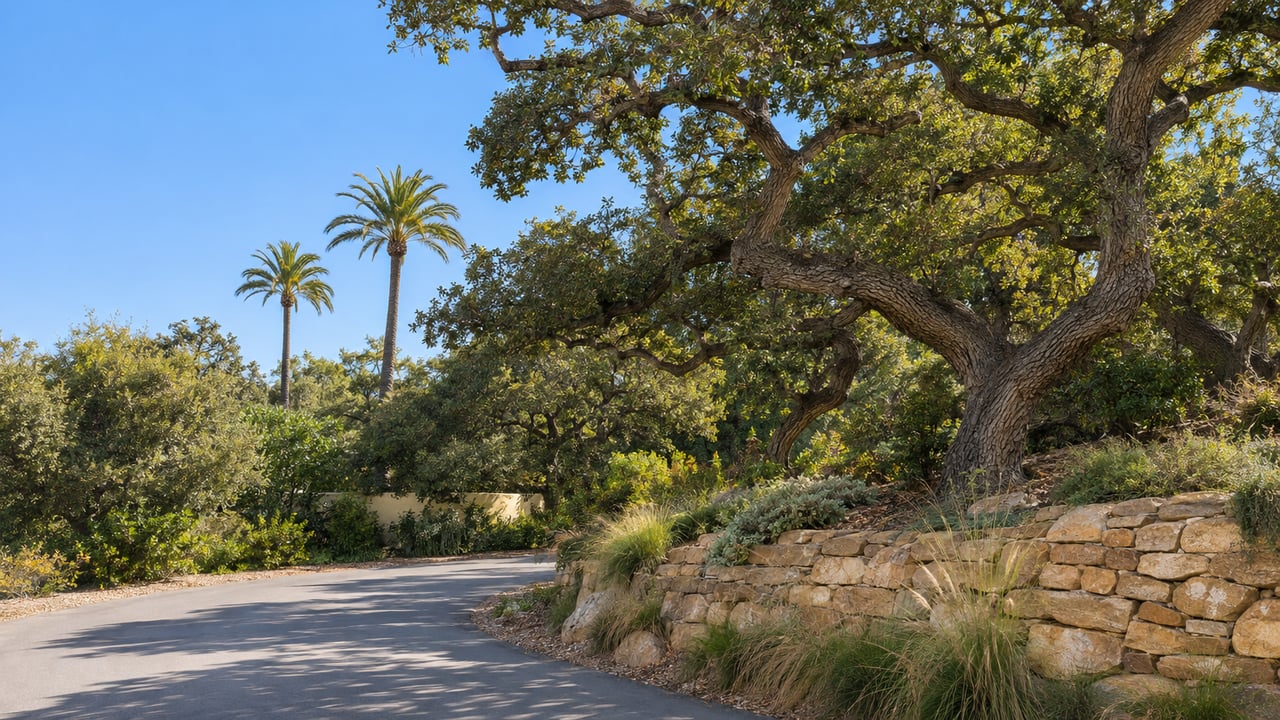
The kiln's location makes sense once you look at the ground Las Palmas Drive follows. Kurilla's paper describes Las Olas Creek, a small stream that is unnamed on official maps. It runs alongside parts of Las Palmas Drive and reaches the sea at Hope Ranch Beach. She quotes geologist Robert M. Norris's 2003 monograph for the Santa Barbara Museum of Natural History:
"The present stream carries too little water to account for the prominent canyon it occupies," Norris wrote, calling Las Olas "a tiny headless stream too small to have created the gorge it now occupies."
According to Norris and Kurilla, a much bigger creek cut that canyon, possibly Arroyo Burro or Cieneguitas, before the land rose and pushed those creeks west. The result is a ready-made passage from Laguna Blanca down to the beach. The Mission's kiln sat in it, and later Las Palmas Drive followed the same route. One drive along Las Palmas takes you from the lake, past the kiln site, down to the shore in a canyon its current creek could never have carved.
The Association also lists the HOA's Las Olas Creek work among its current projects. The October 2026 newsletter says the Creeks & Drainage Committee has finished a draft routine maintenance plan for the corridor beside the bridle trails and roads.
Visiting the Mission This Season
A trip to the Mission is the easiest way to see what the La Calera lime helped build. The self-guided tour runs from 9:30 a.m. Monday through Saturday and from 12:30 p.m. on Sundays, with the last ticket sold at 4 p.m. The audio tour is offered in English, Spanish, French, German, Chinese and Korean. The church and cemetery close to the self-guided route after 3:15 p.m. on Saturdays and from 9:30 a.m. to 12:30 p.m. on Sundays, so a weekday visit covers the whole route. The Mission is closed on Christmas Day.
The 240th founding date falls on a full weekend. In order:
- Friday, December 4, 5 to 8 p.m. The Mission's Sip & Stroll fills the St. Francis Courtyard at 2201 Laguna Street with local artisans, holiday shopping, drinks and food.
- Friday, December 4, 6:30 p.m. The Downtown Santa Barbara Holiday Parade returns to State Street for the first time since 2019, starting at the Arlington and ending at Ortega. Consumer Fire Products, Inc. is the presenting sponsor.
- Saturday, December 5. The Hope Ranch Holiday Party is listed in the Association's October newsletter.
- Sunday, December 13. Two options the following weekend. Explore Ecology's free Arroyo Burro Beach cleanup runs 10 a.m. to noon from the Watershed Resource Center. That evening, the city's 40th annual Parade of Lights has a Hawaiian Holiday theme, with a Winter Wonderland at the harbor from 3 to 5 p.m., the boat parade at 5:30 and fireworks at about 7.
The Sip & Stroll opens at 5 p.m., so on December 4 there is time to see the courtyard before heading downtown for the parade's 6:30 start. The Ranch's own party follows the next day.
For more on the community, our Hope Ranch neighborhood guide covers the beach, the bridle trails and the clubs, and A Hope Ranch Summer, Organized Around a Single Keycard follows the beach season.
At The Morehart Group, we think a Hope Ranch property's history is part of its value, from the rancho grants to the lake and the canyon that set out the roads. If you own a home near Las Palmas Drive and would like to understand its place in that story, request a private consultation with our Montecito specialists.