The season here does not begin with an event on a calendar. It begins the first warm afternoon a resident notices the snack shack door is open again, the lifeguard tower is manned, and the gate on Las Olas Drive is swinging more often than it did in April. For anyone who already lives inside the 1,863 acres, that is the signal. Everything else in a Hope Ranch summer arranges itself around it.
What makes this year worth writing about is not novelty. It is the opposite. A community defined by long-tenured institutions is quietly renovating three of them at once, and the summer rhythm sits on top of that work without pretending anything has changed.
The Keycard Economy
The private beach is public property up to the mean high tide line, but the way in is not. The gated entrance on Las Olas Drive is only for the residents to use, and every resident of Hope Ranch has a card key to the Hope Ranch Beach gate and can enjoy the beachside picnic tables, cabana with bathrooms and storage for kayaks and surfboards. That single detail organizes the social geometry of the sand. The people you see below the bluff on a Saturday in July are, almost without exception, people who live within a two-mile radius of you.
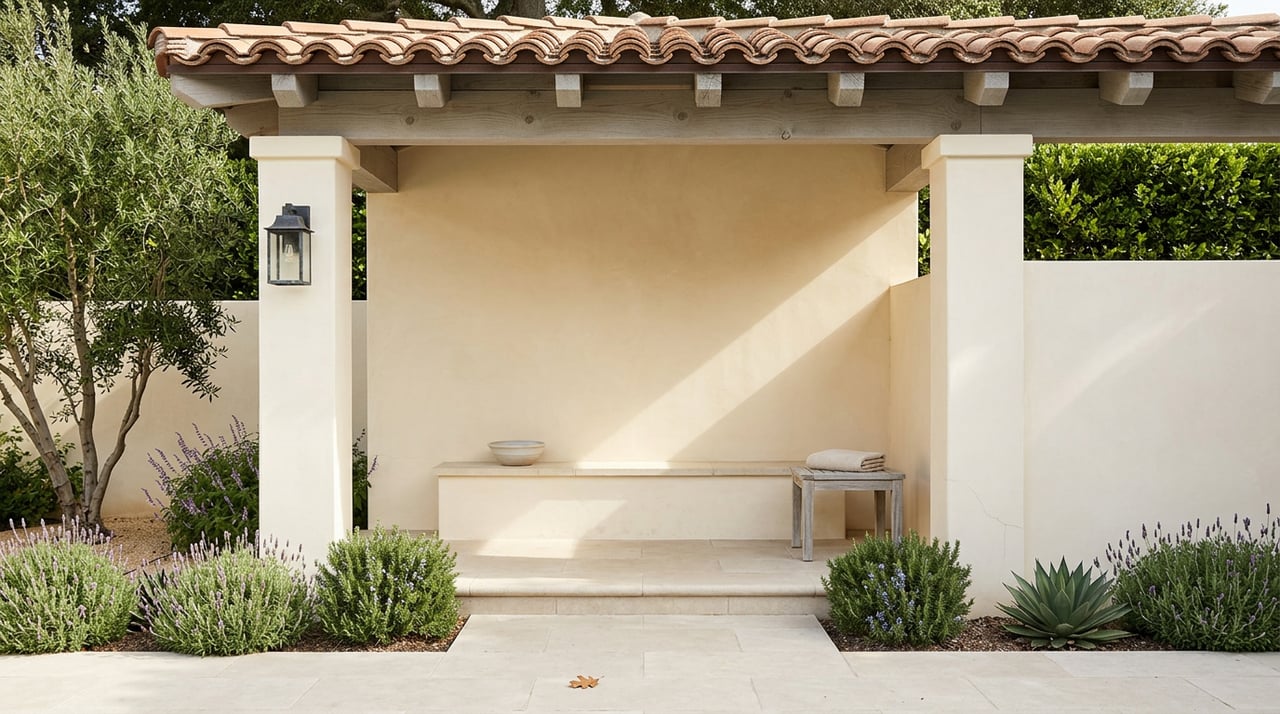
The staffing follows the same logic. The quiet, privately-accessed coastline swells to include lifeguards, a staff of "beach boys," and a food stand each summer, all for the service of Ranch residents and their guests. The bathhouses that anchor the entry point date from the 1920s and have recently been renovated to include lockers, bathrooms, outdoor showers, beach board wash racks, and kayak lock-ups. The building is old. The plumbing is not. That is closer to the truth of Hope Ranch than any single description of it.
The alternative route matters mostly because it clarifies what the keycard buys. A visitor who wants to see the sand has to park on Vieja or Puente, walk in through More Mesa Open Space from Mockingbird Lane, descend the bluff trail, and walk around half a mile east to get to Hope Ranch Beach, and only at lower tides. A resident opens a gate.
| Access point | Who uses it | Getting there |
|---|---|---|
| Las Olas Drive gate | Residents and their guests | Keycard, drive up, park |
| More Mesa Open Space | General public at low tide | Park off Mockingbird, hike the bluff, walk east on sand |
The Ride Down
The other way onto the sand is on horseback, and it is not incidental. The neighborhood boasts 27 miles of riding trails meandering through the flat mesa, rolling hills, and oak trees, and about 10% of people living in Hope Ranch are horse owners. The trail that matters in July is the one that reaches the water. Riders are allowed the dreamy perk of cantering right onto the sandy shoreline of the Hope Ranch Beach.
This is not a decorative amenity. It is a rule of the road. The HOA rule book identifies Hope Ranch as a pedestrian and equestrian community, and some internal bridle trails are reserved for horse use only. In many coastal communities, horses are limited to a niche pocket or a separate riding facility. In Hope Ranch, riding circulation is integrated into the broader neighborhood experience. The default speed limit on most roads is 25 mph for the same reason, because the neighborhood is designed with the understanding that horses are part of normal circulation, not an occasional exception. If you have wondered why the drivers on Marina Drive brake through blind corners in a way that does not match their cars, that is why.
What Is Actually Changing at La Cumbre This Season
The club at 4015 Via Laguna is the other pole of the summer, and it is the piece of the neighborhood in the most visible flux. Nestled between the Pacific Ocean and the Santa Ynez Mountains, in the historic hideaway of Hope Ranch, La Cumbre Country Club offers members a welcome home away from home. In addition to its incomparable golf course, the club includes six championship plexi-pave tennis courts, a spacious and attractive aquatics area, a new state-of-the-art fitness center, and several spots for outdoor dining. The tennis and fitness center was designed to match the historic clubhouse detail-for-detail, down to Saltillo tiles, plaster finishes, and wood materials and finishes, and the pool house sits between the 18th hole and the deck as a summer-party venue that reads as subordinate to the older architecture.
The larger news is the golf course itself. The layout is a George C. Thomas/William Bell private course, opened for play in 1916, and the club has committed to a restoration under architect Todd Eckenrode. The reason it matters to non-golfers is that the course wraps Laguna Blanca Lake, sits inside the sightlines of Laguna Blanca School, and forms the visual center of the north half of the neighborhood.
Reviewers on Golf Digest describe the Eckenrode work as a 2026 project; a member note published later corrects the start to 2027. Either way, the practical read for this summer is the same. The course you play, walk past, or look at from Via Laguna is the course as it has stood, and the restoration is the next chapter, not this one.
Course conditioning has already shifted. Members credit a new director of agronomy, Paul Robertson, with a step-change in the greens over the last two seasons, and the stated plan for the Eckenrode work is to fully restore all the Bell/Thomas holes to their original design. If you live along Via Laguna or Las Palmas, the summer to walk the course as-is is this one.
The Off-Ranch Anchors
Almost nothing about a Hope Ranch summer is self-contained. The Ranch has no restaurant of its own, and the two places most residents end up on a Sunday sit just outside the gate. The Boathouse at 2981 Cliff Drive is inside Arroyo Burro County Park, a five-minute drive from the Las Olas gate, and it functions as the de facto brunch room of the neighborhood. The Boathouse at Hendry's Beach, just past the private access section in the Arroyo Burro Beach County Park, is a popular destination for upscale seafood, brunch, and gorgeous ocean views. Lure Fish House is the everyday alternative, closer to Upper State, and takes the overflow when the Boathouse is on a two-hour wait.
The distance matters because it explains a quiet pattern in the way residents use the neighborhood. The private beach is for morning and afternoon. The public parks and restaurants are for the transition into evening. The Ranch does not compete with Cliff Drive; it hands off to it around five.
The Weekly Sample
One useful piece of information for residents who swim: Hope Ranch Beach is sampled weekly from January 1st to December 31st. Hope Ranch Beach is a private beach for Hope Ranch residents only, although the beach itself is accessible at lower tides from public beaches on either side. The results are posted through Santa Barbara Channelkeeper, with the latest sample taken on March 4th, 2026 and posted to Swim Guide on March 4th, 2026 at 13:23. The one operating rule to keep in mind for the wetter weeks: Santa Barbara County Environmental Health Services advises no swimming for 72 hours following a significant rainfall event. After a June storm, that is the number to remember, not the tide chart.
The One Night the Whole Neighborhood Is on the Sand
The single fixed point of the calendar is the annual family beach camp-out, and it is the summer event that most clearly defines the community's character. Hope Ranch's welcoming array of recreational options and community gatherings, such as the popular annual family beach camp-out each summer, unify the neighborhood and encourage residents to take advantage of the region's average 250+ sunny days. There is no other night of the year when a resident can look east along the cove and see the entire community, on the sand, at the same time.
The Shape of the Season
Read across all of it and a pattern emerges. The summer here is not a program of new openings and pop-ups. It is a residential keycard, twenty-seven miles of trail, a 1916 golf course entering restoration, two 1920s bathhouses that just got new plumbing, a snack shack that reopens on a schedule nobody publishes, and a single camp-out night. The value of living inside this system is that none of it is optional or performative. It is what the neighborhood does every year, whether anyone writes about it or not.
That is also why the year of restoration matters. The renovations are being staged inside the same rhythm that has run since the 1920s. The rhythm does not pause for them. The summer of 2026 is a good one to walk the course, sit on the bathhouse bench, ride the trail down, and pay attention to what is being carried forward.
If you own a home in Hope Ranch and are thinking about how the next chapter of the neighborhood affects your property, or you are considering a private-market sale as the club and beach infrastructure move through renovation, The Morehart Group would welcome a discreet conversation. Work with our Montecito specialists — request a private consultation.