In the three months ending May 2026, the median sale price for a home on the Mesa was $2.1 million, down 11.3 percent from the same stretch a year earlier. In that same window, homes went from listed to under contract in 32 days, down from 57. Thirty-three homes closed, up from 26.
A market that is cooling does not usually behave this way. Falling prices paired with faster sales and higher volume is not the signature of softening demand. It is the signature of a different set of homes moving through the pipeline than moved through it last year. On the Mesa, that distinction matters more than almost anywhere else in Santa Barbara, because the neighborhood is really two housing markets sharing one name.
Two Neighborhoods Wearing One Zip Code
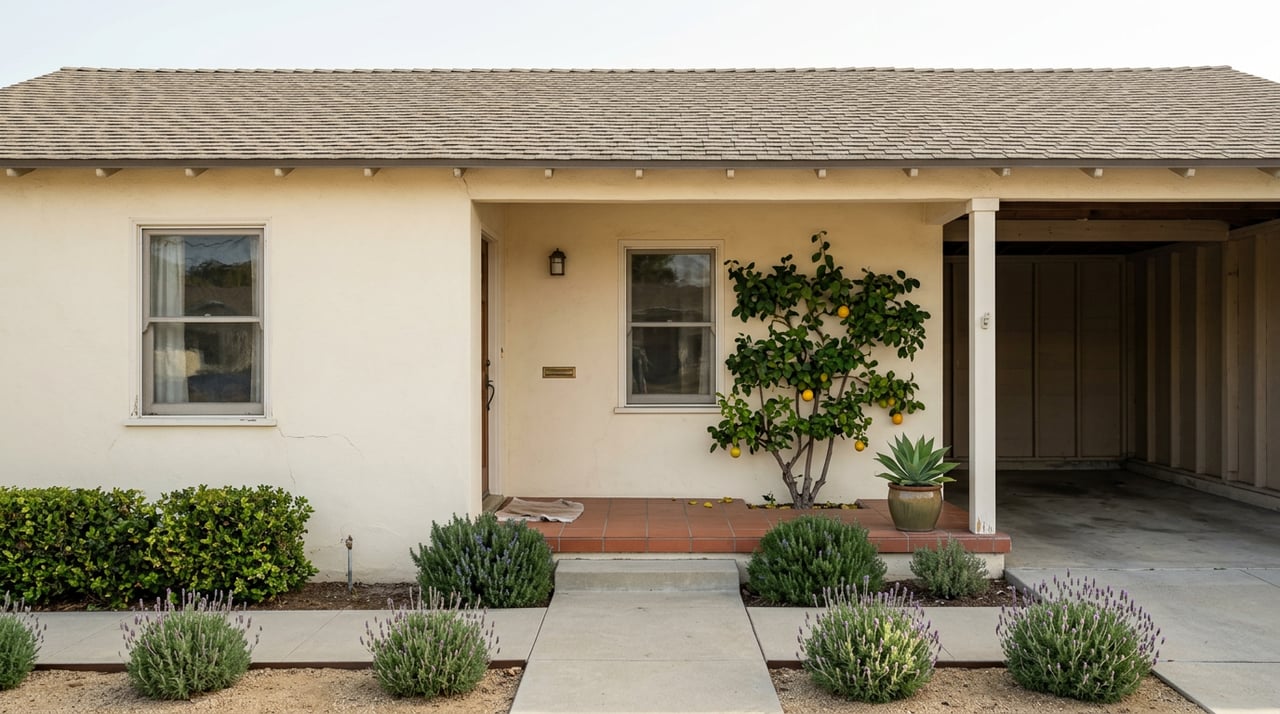
The Mesa splits into East Mesa, West Mesa, and Alta Mesa, a division that shows up in every serious accounting of the neighborhood and reflects a real difference in what sits on the ground. The area came up fast after World War II, when a wave of modest, single-level tract homes went up to house a growing postwar population. That housing stock never really left. It is still the dominant architectural signature of the neighborhood today, sitting alongside a smaller and steadily growing share of ranch houses, shingled cottages, and fully remodeled or newly built homes that trade at a different price entirely.
Santa Barbara City College moved permanently onto the Mesa in 1959, and that single institutional decision has quietly shaped the rental and starter-home economics of the neighborhood ever since. A steady population of students, staff, and short-term renters keeps demand for smaller, original-condition homes near the campus more constant than it is in neighborhoods without that anchor. Cliff Drive runs as the spine connecting these sub-areas, with the neighborhood's commercial life, including the widely used Lazy Acres grocery store, clustered along it.
None of that shows up in a single median. It shows up when you separate the transactions by type.
What a Median Actually Averages Over
A median price only tells you where the middle transaction landed. It says nothing about whether that middle transaction looked like last year's middle transaction. On the Mesa, published price ranges put typical homes somewhere between $1.5 million and $2.5 million, with ocean-view or oceanfront properties starting around $1.75 million and running to two or three times that, larger or fully remodeled homes clustering in the $2 million to $3 million range, and condos generally trading between $800,000 and $1.25 million.
That is a wide enough spread that a shift in which tier is transacting can move the reported median by double digits without a single comparable property losing value. If more original-condition tract homes near SBCC changed hands in this window, pulled by steady rental and starter-buyer demand, while fewer large remodeled or view properties closed, the median would fall exactly the way it did, even in a neighborhood where individual homes are holding their price.
This is not unique to the Mesa. Countywide data for the second quarter of 2026 showed the same mechanism at a larger scale: the average single-family sale price across South Santa Barbara County jumped 21 percent even as the median slipped 2 percent, a gap explained by a concentration of high-value closings pulling the average up without lifting the broader market. The lesson travels in both directions. Averages and medians move when the mix of what is selling changes, not only when values change, and a buyer or seller who reads either number as a verdict on their specific property is reading the wrong instrument.
Here is roughly what those tiers translate to on the ground:
| Price tier | What it typically represents |
|---|---|
| $800K to $1.25M | Condominiums and townhomes |
| $1.5M to $2.5M | Original or lightly updated single-family homes, often 1950s tract stock |
| $1.75M and up | Ocean-view or oceanfront properties, with premiums scaling steeply from there |
| $2M to $3M | Larger or fully remodeled single-family homes |
The gap between the first and last row is not a description of the neighborhood weakening or strengthening. It is a description of how many different products the word "Mesa" is being asked to cover.
The Renovation Question That Actually Moves the Needle
For a buyer weighing an original 1950s home against a remodeled one at nearly double the price, the honest question is not whether the remodeled version is worth more. It obviously is, based on the tiers above. The honest question is how hard it would be to close that gap yourself, and that is where the timeline gets less forgiving than most buyers expect.
Mesa properties fall under the City of Santa Barbara's building and permitting jurisdiction, the same office that handles the Riviera, San Roque, and Samarkand, as distinct from Hope Ranch, Montecito, and Mission Canyon, which run through the county instead. That distinction matters because the City's process changed meaningfully at the start of this year. Beginning January 2, 2026, all new building permit applications in the city are required to comply with the 2025 California Building Standards Code, following a December 17, 2025 cutoff for projects still eligible for review under the prior code cycle. Anyone buying an original-condition Mesa home with plans to renovate is now working entirely within the newer code.
The practical timeline for a straightforward kitchen or bathroom remodel, the kind most Mesa tract homes need, generally runs two to four weeks for initial review when the project is simple enough to avoid corrections or additional agency sign-off. Projects that trigger structural changes, window modifications, or design review corrections commonly stretch to six to ten weeks. Fees scale with scope as well, with standard bathroom-level remodels running roughly $450 to $1,200 in combined plan check, permit, and inspection costs, and projects involving structural or window work running $1,000 to $2,500. The county has also been working to shorten these timelines system-wide. The Board of Supervisors took up a package of ordinance streamlining amendments at its January 27, 2026 meeting, part of a broader effort to make permit review more predictable across the region.
None of this is a reason to avoid an original-condition Mesa home. It is a reason to price the renovation runway into the offer rather than assuming the gap between a $1.6 million tract home and a $2.4 million remodeled one closes in a single summer.
Where the Premium Actually Sits
The properties commanding the top of the Mesa's price range are not simply the newest or the largest. They tend to cluster near two specific amenities that anchor the neighborhood's identity: Shoreline Park, a bluff-top stretch of lawn and coastal trail, and the Douglas Family Preserve, seventy acres of oceanfront open space at the Mesa's southwestern edge. Proximity to either does more to explain a price premium than square footage alone, and it is a detail that a median obscures completely, since a modest original home two blocks from the preserve and a similarly modest home ten blocks inland can carry meaningfully different values despite showing up as the same "Mesa" data point.
That is the real thesis behind this year's numbers. The Mesa's falling median is not a market weakening. It is a market with two distinct products, original-stock family and rental-adjacent housing on one side, remodeled and view-oriented properties on the other, and this year's transaction mix simply leaned harder toward the first group. Reading that correctly is the difference between a buyer who walks away thinking the neighborhood is softening and one who understands exactly which segment they are shopping in.
A Few Questions Worth Answering Directly
Does a falling median mean Mesa home values are dropping? Not necessarily. The data reflects which homes transacted in a given window, not whether comparable homes are worth less than they were a year ago. Faster days on market and higher sales volume alongside a lower median point toward a shift in transaction mix rather than a decline in underlying value.
How do I know if a Mesa property I am considering is original 1950s stock or has been substantially remodeled? The price tier is often the clearest early signal. Homes priced well under $2 million are more likely to be at or near original condition, while properties above $2.5 million have typically had significant work done, particularly if they carry a view premium.
Does buying on the Mesa mean dealing with the city or the county for permits? The city. Mesa properties fall under City of Santa Barbara jurisdiction for building permits, the same office handling the Riviera and San Roque, which is a different process and timeline than county jurisdictions like Hope Ranch or Montecito.
If you are trying to figure out which side of the Mesa's market a specific property actually sits on, or what a renovation timeline would realistically look like before you write an offer, that is exactly the kind of read The Morehart Group does for clients across Santa Barbara County. Work with our Montecito specialists: request a private consultation.